


Unsecured
Debt Collectors

What To Say When Fake Debt Collectors Call:

I am revoking consent for you to contact me any further!
You may only send me written correspondence from this point forward
Please validate this debt!
Send me proof that I am legally obligated to pay you!!
Demand Deeds of Assignment
The insurance claim of debt & verify if the debt is within the Statue of Limitations!
Provide the original written agreement with my signature agreeing to pay!
I need a copy of the last billing statement from the original creditor!
I need proof that you are authorized to collect this debt on behalf of the creditor!

IMPORTANT – TAKE CONTROL!

Always remain calm and courteous. Do not lose your temper. If the caller cannot — or refuses to — provide the information you’ve requested, simply thank them for their time and end the call politely.

UNDERSTANDING THE FAKE DEBT SCAM

The Three Stages of Fake Debt Collectors

Understanding How Written-Off Debts Are Exploited by Fake Debt Collectors
What Are “Fake Debt Collectors”?
Fake Debt Collectors are companies that purchase written-off or unenforceable debts for pennies and then pursue the original borrower for the full amount — often without any legal right to do so.
These collectors buy data, not verified debts, and rely on fear, confusion, and a lack of consumer awareness to profit from accounts that have already been written off by the original lender.
A bank or lender creates a loan — effectively generating the money from nothing through its own lending system. You begin repaying it, with interest, under a standard credit agreement.
If you fall behind on payments, the account goes into default and is marked as a bad debt. At this stage:
  • The bank writes off the balance as a loss.
  • HMRC (the tax office) compensates the bank for that loss under accounting and tax rules.
  • The debt is no longer a genuine asset of the bank.
The written-off account is sold to a Debt Purchasing Company (DCP) — also known as a Fake Debt Collector — for a tiny fraction of its value, sometimes just pennies in the pound.
Despite this, they still demand the full original amount.
In reality, what is sold is often incomplete or inaccurate data, not a legally transferred debt.
This is how debts that should be long closed are “brought back to life.”

The Legal Side: Assignment of Debt

The Agreement Between Companies
When a debt is transferred from the original lender (the Assignor) to a debt purchaser (the Assignee), there are two possible types of assignment:
  1. Equitable Assignment – an informal arrangement allowing the DPC to collect money on behalf of the original creditor.
  2. Legal Assignment – a formal transfer of ownership that complies with Section 136 of the Law of Property Act 1925.

What Makes an Assignment “Legal”?

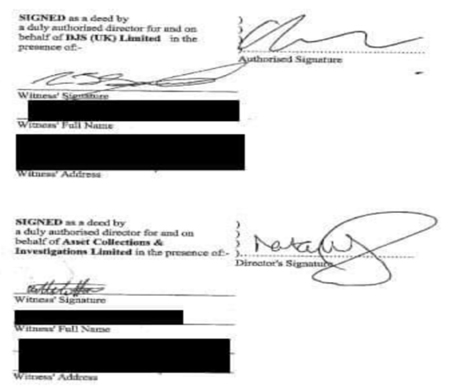
For an assignment to be legally valid in the UK, there must be a Deed of Assignment that:
  • Complies with the Law of Property Act 1925.
  • Is signed by two directors of the Assignor company, or one director and a company secretary, and bears the company seal.
In reality, this is rarely done. Debts are usually sold in large batches, and issuing an individual signed deed for each account would take far too long.

Real Deeds of Assignment Example

The Problem with “Notices of Assignment”

Fake Debt Collectors often rely on a Notice of Assignment — a letter claiming that they now own your debt.
However, this notice does not prove ownership. Anyone could print a letter saying you owe them money.
Without a valid Deed of Assignment, a DPC cannot legally enforce the debt without the original creditor joining the case.

This was confirmed in Van Lynn Developments v Pelias Construction Co Ltd (1968), where Lord Denning stated that “the debtor is entitled to view the sale agreement to ensure that the assignee can give him good discharge under the contract.”

Why Fake Debt Collectors Exist

Banks often sell data lists, not legitimate debts. These lists may contain:
  • Outdated contact details
  • Incomplete or missing records
  • Statute-barred debts (too old to enforce)
  • Accounts already sold or settled
Because these debts cost so little to acquire, even collecting a small fraction makes the trade highly profitable.

The Harsh Truth

The original lender has already written off the bad debt and received a tax benefit for doing so.
Even HMRC recognises that the debt no longer exists.
Many Debt Purchasing Companies partner closely with law firms — sometimes owned by the same people — to turn unsecured debts into secured debts using County Court Judgments (CCJs).
This allows them to:
  • Secure the debt against your home
  • Apply for Orders for Sale or Possession
  • Ultimately force you to sell your property.
The profits from these arrangements are substantial — and they depend on borrowers not knowing their rights.

Why You Must Request the Deed of Assignment

Because “A” (the bank) sells or claims to sell a debt to “B” (the Fake Debt Collector), you have the right to demand proof of ownership.
Without a valid Deed of Assignment, the DPC cannot legally collect from you. A Notice of Assignment alone does not meet the requirements of:
  • Law of Property (Miscellaneous Provisions) Act 1989, Section 1(3)
  • Companies Act 2006, Section 44
  • Regulatory Reform (Execution of Deeds and Documents) Order 2005
  • Law of Property Act 1925, Section 136
If these legal requirements are not met, the collector has no legal title to the alleged debt.

Understanding the Deed and Notice of Assignment of Debt

What Happens When a Debt Is Sold

When a debt is sold or transferred to another company, that company must be able to prove they have the legal right to collect it.

This proof comes in the form of a Deed of Assignment of Debt.

Typically, the Deed of Assignment should be created within seven days of the debt being purchased or the right to collect being transferred.

You have an absolute legal right to request a copy of this document.

The “Notice of Assignment” — What It Really Means

Usually, before a Deed of Assignment is shown, you’ll receive a Notice of Assignment — a letter from the new company stating they have bought or are now collecting your debt.

For many people, this is the first letter they receive and often ignore, but it’s important to understand what it really is:

  • The Notice of Assignment simply informs you that your debt has been sold or transferred.
  • It does not prove that the transfer was lawful or valid.
  • It is not a legal document — it’s only a notification.

Anyone can send a letter claiming to have bought a debt, but unless they can provide a valid Deed of Assignment, they have no enforceable right to collect that debt.

What Makes a Deed of Assignment Valid?

A Deed of Assignment is a legal document that transfers ownership of a debt from the original creditor to a third party (the debt purchaser).

For it to be legally valid, it must:

  • Be signed by both parties (the original creditor and the purchasing company).
  • Be witnessed by someone independent of both companies — typically a solicitor or legal professional.

If these requirements are not met, the document is not legally valid, and the debt purchaser cannot lawfully enforce the debt in their own name.

Why Most Debt Companies Don’t Produce a Deed of Assignment

In practice, debt collection companies rarely provide the Deed of Assignment when requested.

That’s often because:

  • Debts are sold in large batches using bulk transfer agreements that only include lists of names, account numbers, and balances.
  • These lists are not individually signed or witnessed.
  • Many contain errors, outdated information, or even statute-barred debts (debts too old to enforce).
  • When asked for proof, companies may claim “commercial sensitivity” to avoid disclosing the document — even in court.
Essentially, they’re relying on the assumption that you won’t challenge them or that you’ll accept their claim at face value.

The Bottom Line

  • The Notice of Assignment is not proof that a debt has been legally transferred.
  • The Deed of Assignment is the only valid proof — and you can legally request a copy.
  • Without it, a debt collection company cannot lawfully enforce or pursue payment in their own name.
If you’re contacted by a company claiming you owe a debt, always ask for the Deed of Assignment — and don’t accept a notice letter as proof.
Fake Debt Collectors buy written-off debts for as little as 8–12% of their face value — then chase the public for 100%.

Always:

If the collector can’t prove ownership with a valid Deed of Assignment, then in law — the debt doesn’t exist.

Welcome to the Sovereign Reserve Repair Program

This website has been created by former MatrixFreedom staff and members to support individuals who have experienced financial hardship in connection with Iain Clifford and the Sovereign Reserve Program.

The information provided here is for educational and informational purposes only and is completely free to access.

We also operate a separate website, MatrixFreedom Exposed, which documents the full history of events, including misleading claims and business practices, and outlines the steps being taken to prevent further harm.

👉 For more information, please visit: www.matrixfreedomexposed.info